
Key Takeaways
- Demonstrating a clear understanding of a prospect’s portfolio early in the relationship can help create a more relevant, prepared experience.
- Defining an ideal HNW client by operational capacity rather than a generic asset threshold can help firms align acquisition with the complexity they are best equipped to serve.
- A structured approach to COI relationships can help firms build more intentional referral networks.
- A firm's digital presence can function as a trust audit for sophisticated prospects. Websites that clearly articulate who a firm serves and show relevant expertise can help prospects more easily assess the firm’s relevance and fit.
- The ability to move from a prospect's raw statements to objective insights and client-ready deliverables can help advisors demonstrate value earlier in the acquisition process.
Much of the conversation around attracting high net worth clients focuses on the top of the funnel. It emphasizes networking, credentials, and marketing channels, but what happens after a prospect agrees to meet can be just as important. Consider an illustrative scenario: an advisor spends months cultivating a relationship with a center of influence (COI), gets an introduction to a $5M household, and arrives at the discovery meeting with materials that are clear but not especially tailored to the prospect's situation. The analysis may have taken hours to prepare, yet it does not fully show the depth of understanding the prospect expected.
For many firms, attracting HNW clients is not only a marketing challenge, but also a preparation and presentation challenge. Marketing, positioning, referrals, and thought leadership help create the opportunity. What happens next often shapes whether that opportunity progresses. When a prospect sits down for a first meeting, the advisor's ability to turn raw financial data into objective insights and client-ready deliverables can become a meaningful differentiator. This guide explores that often-overlooked part of the acquisition experience and the workflow behind winning the meetings that matter .
Why the Work After the Introduction Matters
Top-of-funnel tactics such as credentials, networking events, LinkedIn content, and COI relationships are important, but the workflow that follows once a prospect engages deserves equal consideration. In practice, one important part of the acquisition challenge is the speed and quality of what happens between that first introduction and the delivery of a thoughtful analysis.
Consider an illustrative scenario: an advisor receives a referral from an estate attorney for a recently widowed client with $3M spread across four different custodians. The advisor requests statements, then an analyst or associate spends days entering data into spreadsheets, assembling comparison materials, and scheduling a follow-up. By the time the advisor presents their findings, the prospect may already have met with other firms. The contrast in preparation can shape whether that conversation feels tailored and substantive or still in progress.
Another illustrative example helps clarify the point. One advisor brings a relatively high-level portfolio review to a first meeting. Another firm presents fee analysis, concentration details, and a portfolio transition view that is more closely tied to the prospect's specific holdings. In cases like this, the prospect may leave with different impressions about how each advisor approaches preparation and portfolio complexity.
Factors that may shape a HNW prospect’s evaluation include how quickly the advisor demonstrates an understanding of the prospect's situation, how clearly the advisor explains where value may be added, and how professional and objective the materials look. These are often shaped by preparation workflow as much as by marketing. For firms focused on attracting high net worth clients, the ability to turn complex, multi-account data into objective insights and client-ready deliverables can be an important part of the acquisition experience.
Read more: VRGL Launches Client Transition and Proposal Offering | VRGL
Defining the HNW Client a Firm Is Set Up to Serve
For firms pursuing HNW clients, clearly defining what that segment means for their practice can be important for both positioning and capacity planning. Two considerations often shape the acquisition workflow that follows: how a firm thinks about client capacity, and whether it has a clear focus on a particular client type.
Wealth Segmentation Is an Operational Decision, Not Just a Label
The commonly cited $1 million threshold for HNW can be a useful reference point, but definitions vary across the industry and may be based on investable assets, liquid assets, or net worth. Many firms find that service model fit is the more practical lens. A firm with two advisors and no dedicated planning staff may serve a $2M household very differently than a firm with a CIO, tax specialists, and estate planning partnerships.
Rather than relying on rigid thresholds, firms often segment based on the level of planning complexity, service intensity, and internal capacity required to support the relationship well. It is also important to distinguish between investable assets and net worth. A business owner with substantial illiquid wealth may require a very different engagement model than a retiree with a similar level of liquid portfolio assets.
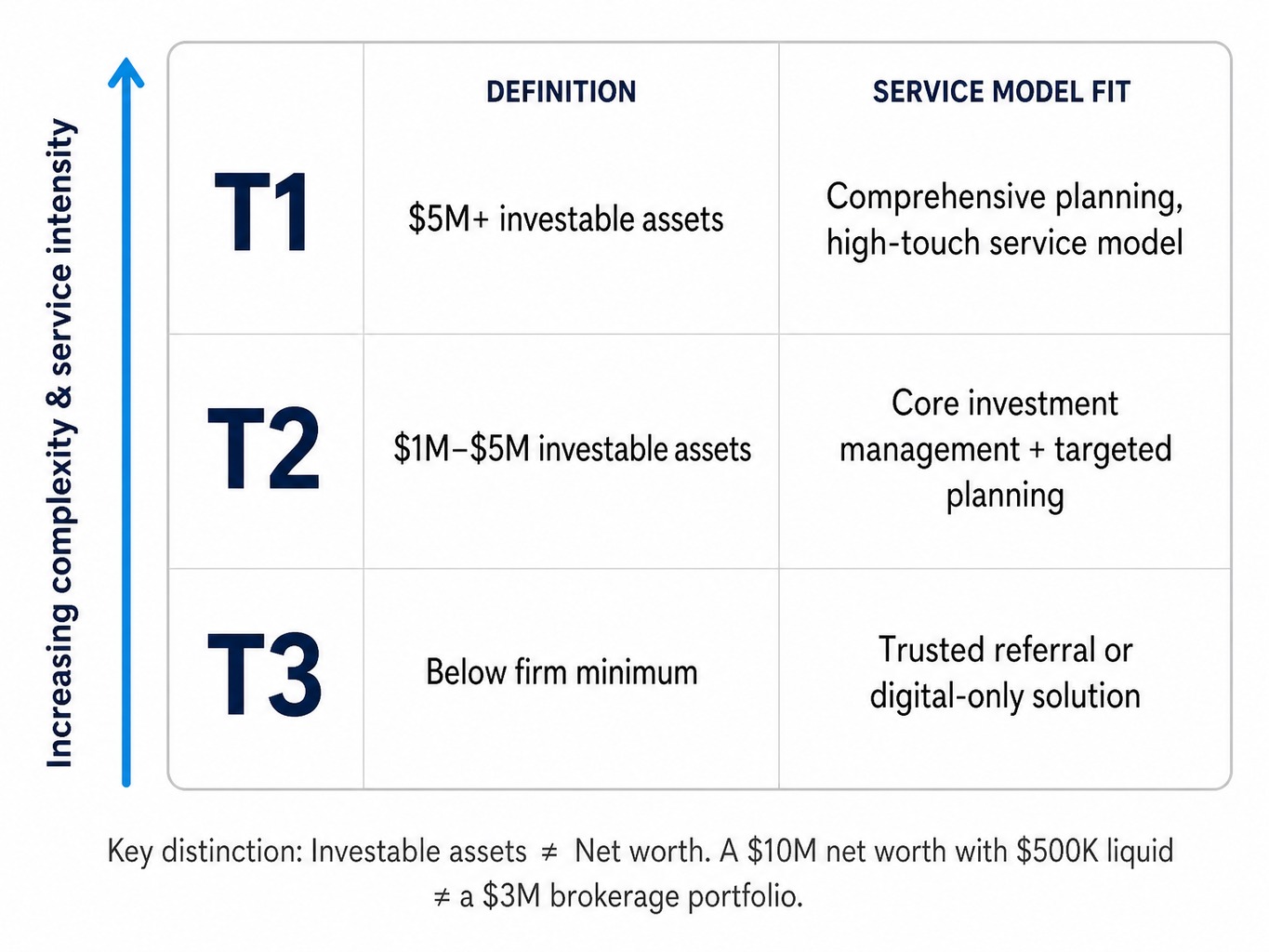
Service capacity can be another consideration when defining HNW client segments.
Niche Specialization Can Strengthen Relevance
Advisors who serve a defined professional cohort, such as physicians approaching partnership, tech executives with concentrated stock positions, or business owners planning exits, may find that specialization strengthens relevance over time. Each client engagement can deepen domain knowledge, COI relationships may become more aligned, and content can speak more directly to a specific audience.
Consider an illustrative scenario: an advisor specializes in dentists selling multi-location practices. That advisor may already understand DSO valuations, practice transition timelines, and the considerations around asset versus stock sales. When a dental CPA refers a client, the conversation can begin with more context. This kind of specialization can become a compounding advantage because it signals relevant expertise before the first conversation begins.
How COI Relationships Can Support Acquisition
Some firms may choose to structure COI relationships more intentionally around clearer communication, client fit, and tangible value for referral partners. In that context, a COI referral can differ from a typical warm lead because the referring professional has put their own credibility behind the introduction.
Strategic Reciprocity vs. Casual Networking
COI relationships can include a clearer understanding of which type of client the firm serves best and how the firm supports a prospect once an introduction is made. That clarity can make it easier for referral partners to recognize when a potential introduction may be a strong fit.
What Turns a COI Relationship Into a Consistent Referral Source
Firms may also consider how tangible value supports these relationships, not simply how often they ask for introductions. Consider an illustrative scenario in which a COI receives something useful from the advisor, such as a co-branded analysis or portfolio review summary they can share with a client. That kind of material can help the COI feel more confident making the introduction, and it connects directly to the broader acquisition workflow the advisor uses once a prospect engages.
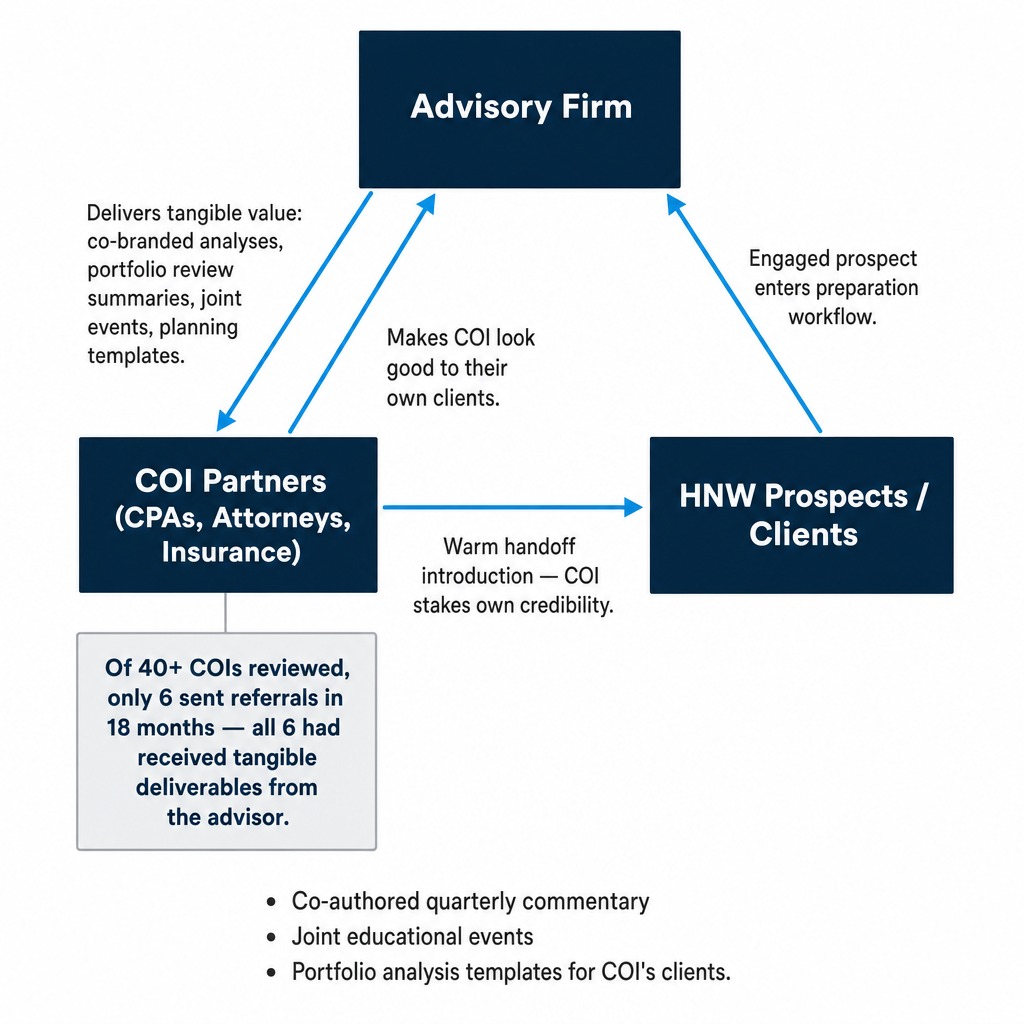
A structured approach can bring greater consistency to how firms manage COI relationships.
How HNW Prospects Evaluate Advisors
How HNW prospects evaluate advisors can vary widely by client type, referral context, and complexity of need. In some cases, firms may find that high net worth prospects are less responsive to broad lead-generation tactics and more influenced by trust signals that build over time. A colleague may mention the firm, a prospect may encounter relevant content while researching a planning question, or firm materials such as an ADV Part 2A and website may become part of the evaluation process. In that context, marketing to HNW individuals can involve not only reach, but also building a body of evidence a sophisticated prospect can review on their own terms.
Thought Leadership That Signals Depth, Not Volume
Some firms find that HNW prospects respond more to content that reflects specific expertise than to general market commentary. Material that speaks clearly to concentrated equity compensation, liquidity events, or business-sale planning may signal more relevant expertise than a high volume of broad updates.
A detailed analysis of the planning considerations around concentrated equity compensation for tech executives, for example, may carry more weight than a large library of general market commentary. Thought leadership that supports attracting high net worth clients can also operate on a longer evaluation cycle. Content on a specific issue, such as concentrated stock risk, can remain relevant throughout a longer evaluation process. Channels such as LinkedIn, guest contributions in established publications, or niche professional outlets can give firms opportunities to distribute relevant expertise to targeted audiences.
A Digital Presence as a Trust Audit, Not a Lead Funnel
In this context, a website can serve not only as a lead-generation channel, but also as a trust and due-diligence touchpoint. If the site does not clearly communicate who the firm serves or how it thinks, the prospect may have a harder time assessing fit.
A trust-oriented digital presence may include a clear articulation of who the firm serves, anonymized case examples that show how it approaches relevant problems, professional design, and easy access to important firm information such as ADV and fee structure. Some firms also choose to signal selectivity in how they describe new-client fit. The broader point is not that every firm should structure its website the same way, but that a digital presence that supports due diligence often aligns better with how HNW prospects evaluate advisors.
Why the First Meeting Matters
The first meeting can be an important point in how a HNW prospect evaluates an advisor. In many cases, the distinction comes less from what is said and more from what is shown.
Consider an illustrative contrast. In one common pattern, an advisor enters the discovery meeting with a capabilities presentation and asks the prospect to send over statements for a follow-up analysis. In another pattern, an advisor enters having already reviewed the prospect's portfolio data from statements shared during the introduction and presents a clear, branded view of current allocation, risk exposure, fees, tax considerations, and concentration exposures.
In the second pattern, preparation can give the prospect a clearer view of how the advisor approaches the situation. Credentials may help an advisor enter the consideration set, but early analysis can create a more substantive starting point for the conversation.
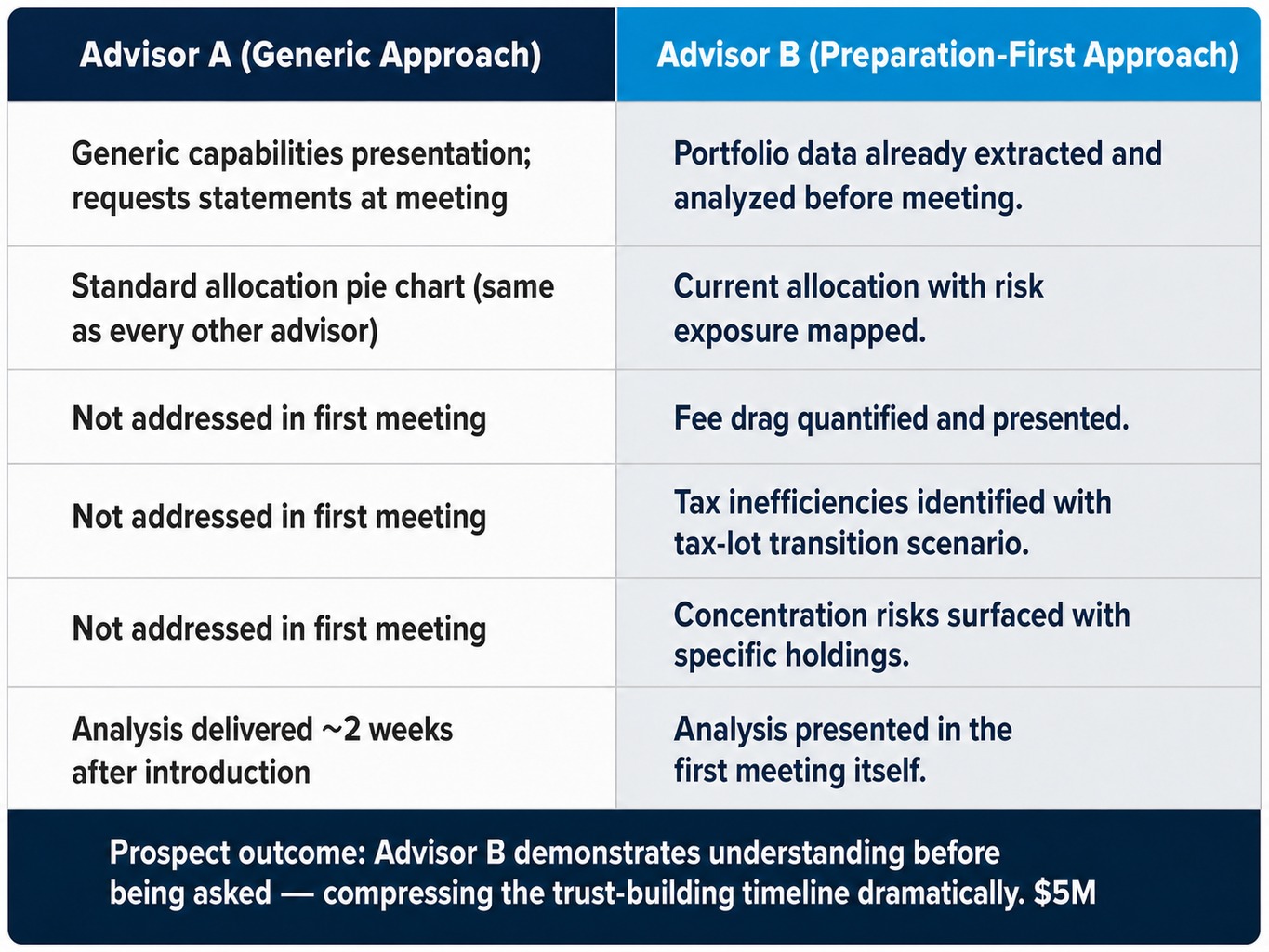
Preparation can help advisors bring greater clarity and relevance to HNW prospect conversations.
The ability to move from raw statement data to objective insights and client-ready deliverables can be a meaningful differentiator in attracting high net worth clients. An efficient, repeatable workflow can help advisors spend less time assembling analysis and more time preparing for meaningful prospect conversations. Firms looking to scale a financial advice practice may benefit from this kind of consistency at the center of the acquisition experience.
How VRGL Supports the HNW Acquisition Workflow
VRGL is the Growth Platform for wealth management firms. Within that broader platform, VRGL Core supports the acquisition workflow by helping firms move from prospect statements to objective insights and client-ready proposals and reports with greater consistency and less manual effort.
The workflow begins with statement extraction that converts multi-custodian investment statements into structured data, reducing manual data entry. From there, advisors can review objective analysis and insights across performance, risk, diversification, taxes, and fees. Those insights can then be carried into client-ready proposals and reports with firm-controlled branding and disclosures, helping teams present their work with greater clarity and consistency.
For independent advisors , this can support a repeatable path from data intake to prospect-ready deliverables. For enterprise firms , it can support more consistent preparation standards across advisors and teams while preserving advisor flexibility. In that way, VRGL Core supports an important part of the acquisition experience, helping advisors spend less time assembling analysis and more time preparing for meaningful prospect conversations.
See how VRGL helps advisory firms move from statements to client-ready presentations
From Marketing Funnels to Preparation Workflows
One useful shift for advisors seeking to attract high net worth clients may be to view acquisition more holistically. Marketing, positioning, COI ecosystems, and thought leadership can help create opportunities for engagement. Once a prospect engages, the preparation workflow becomes another important part of the acquisition experience. The ability to turn raw prospect data into objective insights and client-ready deliverables can help firms bring greater consistency, clarity, and personalization to the prospect experience. As firms scale, repeatable acquisition workflows can support a more prepared first conversation and a more consistent way to demonstrate value.
See how VRGL can support your firm’s acquisition workflow
Frequently Asked Questions
What is the standard investable asset threshold for a high net worth client?
The commonly referenced threshold is $1 million, though definitions of high net worth vary across the industry and may be based on investable assets, liquid assets, or net worth. Ultra-high net worth (UHNW) is often associated with $30 million or more, but here too, definitions can vary by source and methodology. In practice, many firms also distinguish between investable assets and total net worth when evaluating fit.
How can advisors approach AUM minimums while maintaining referral relationships?
Some firms choose to communicate minimums clearly while also maintaining a referral path for prospects who are not a fit for their core service model. That approach can help preserve referral relationships while creating more clarity around who the firm is best equipped to serve.
What compliance considerations apply when marketing advisory services to high net worth individuals?
Marketing advisory services to any client segment involves regulatory considerations that can vary based on the firm's registration status, jurisdiction, and the specific content or arrangements involved. Firms may want to consult qualified compliance counsel when developing marketing content, referral arrangements, or claims about expertise or outcomes.
What psychographic traits distinguish high net worth clients from mass affluent clients?
Client preferences vary widely, so broad behavioral generalizations are not always helpful. In many cases, what matters more is whether the advisor can demonstrate relevance, clarity, and a thoughtful understanding of the prospect's specific financial situation.
How can advisors use wealth intelligence tools to identify HNW prospects?
Wealth intelligence platforms use public and other available data to help firms identify prospects who may align with a target client profile. These tools can support prioritization, but the quality of the prospect experience still depends on how well the firm handles the acquisition workflow once engagement begins.
How do you retain high net worth families across multiple generations?
Approaches to multi-generational relationships vary by firm and client need. At a high level, continuity often depends on whether the firm can provide a consistent experience, communicate clearly across stakeholders, and remain relevant as family circumstances evolve over time.