
Key Takeaways
- The annual review checklist can be reframed from a list of topics to a repeatable workflow covering data preparation, analytics, the meeting itself, and post-meeting documentation.
- A systematized pre-meeting preparation process, especially for consolidating held-away and multi-custodian account data, can support a more complete household view.
- The portfolio analytics layer can be structured around objective measures like asset allocation drift against the IPS and sleeve-level performance attribution, not just market commentary.
- Firms may consider standardizing the review process across advisors to support consistency, firmwide visibility, and the firm's governance framework.
- The checklist can extend beyond the meeting to include a structured follow-through workflow for documenting discussions, assigning action items, and delivering a client summary.
Financial advisor annual review checklists are often organized around categories such as retirement, insurance, estate planning, and taxes. Another useful way to structure the review is around the workflow required to prepare, conduct, and follow through on the meeting.
Pre-meeting preparation can help advisors enter the review with more complete data and a consistent analytical foundation. When preparation is treated as an ad hoc task, a significant share of a team's time can go to data entry and reconciliation. When it's treated as a system of work, the process can become more repeatable and easier to scale. This article provides a framework for advisors and advisory teams to structure their annual review workflow. It moves sequentially through the operational stages of a well-prepared review: scoping the agenda, preparing the data, running the analytics, reviewing planning items, and creating a documented record that supports the firm's own governance.
This article is for informational purposes only and does not constitute investment, legal, tax, or compliance advice. Your client review process remains subject to your firm's specific policies and regulatory obligations.
Portfolio Review vs. Comprehensive Planning Review: Why the Distinction Shapes Your Agenda
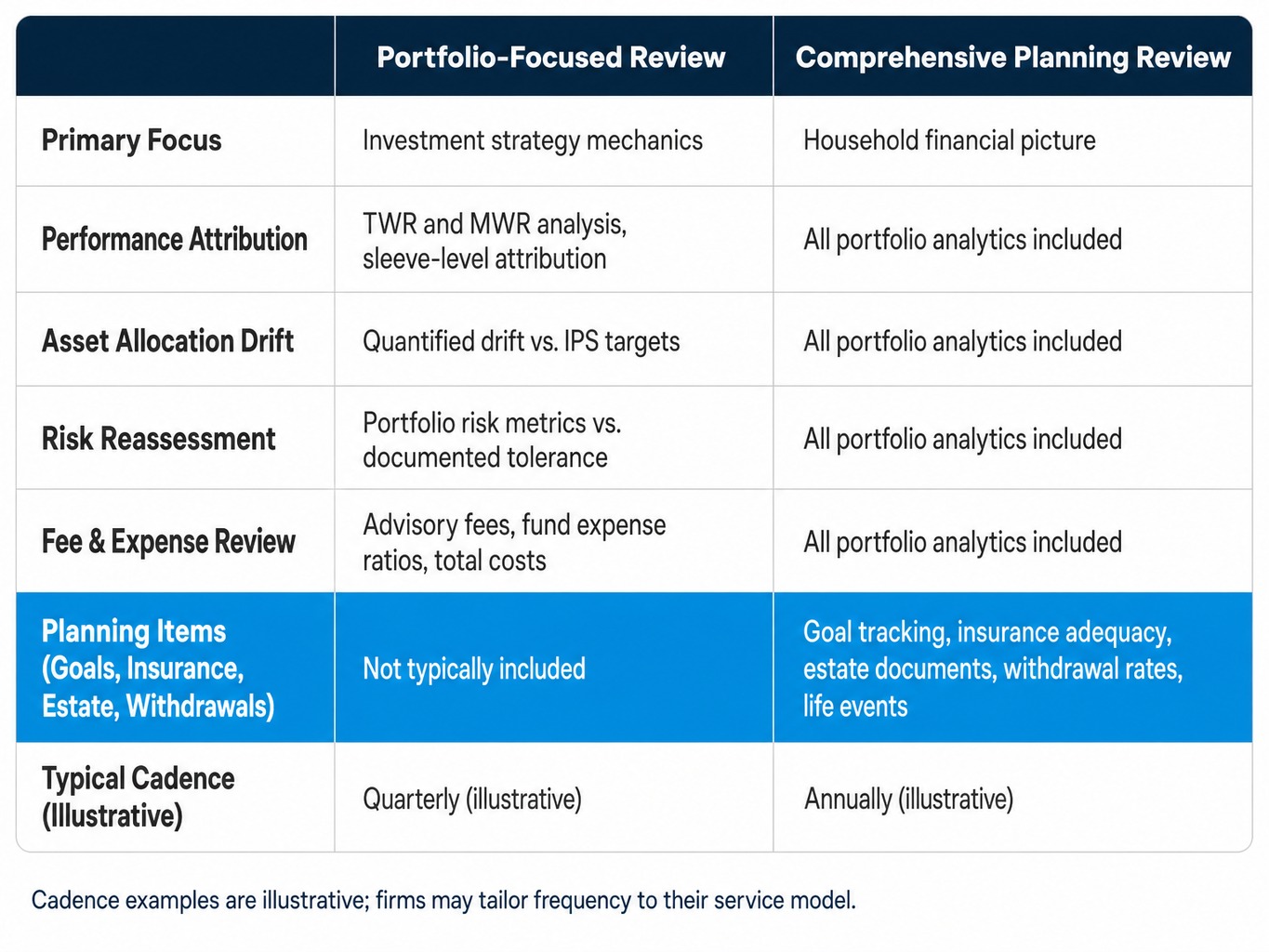
Firms may structure reviews differently depending on the purpose of the meeting and their client service model. A single approach can lead to either a surface-level portfolio check-in that misses critical planning gaps or a sprawling planning conversation that never gets to investment specifics. Distinguishing between a portfolio-focused review and a comprehensive planning review allows firms to align the meeting's depth and cadence with their client service model.
For example, a firm with a tiered service model might choose different review types or cadences based on the scope of service provided. The checklist items required would vary with the type of review being conducted.
What a Portfolio-Focused Review Covers
A portfolio-focused review is data-intensive, concentrating on the mechanics of the client's investment strategy. Depending on the firm's review framework, areas of analysis may include:
- Performance Attribution: Analyzing where returns came from, often contextualizing both time-weighted returns (TWR) to evaluate manager performance and money-weighted returns (MWR) to reflect the client's cash-flow timing. This can extend to sleeve-level attribution for more complex portfolios.
- Asset Allocation Drift: Measuring the current portfolio allocation against the targets defined in the Investment Policy Statement (IPS). This analysis can be more precise when it quantifies drift within specific tolerance bands rather than describing it anecdotally.
- Risk Reassessment: Comparing the portfolio's current risk metrics to the client's documented risk tolerance.
- Fee and Expense Review: Providing transparency into advisory fees, fund expense ratios, and other costs.
- Held-Away Account Positioning: Reviewing the allocations of outside accounts to understand the total household exposure.
This type of review benefits from structured, repeatable analytics that can be generated efficiently, rather than from ad hoc spreadsheet work.
What a Comprehensive Planning Review Adds
A comprehensive planning review may extend beyond portfolio analysis to broader financial planning considerations. These items may involve different data sources such as planning software, insurance records, and estate documents, along with a distinct preparation workflow. Potential areas of review include:
- Goal Tracking: Measuring progress toward specific financial goals like retirement, education funding, or a major purchase.
- Insurance Coverage Review: Assessing the adequacy of life, disability, and long-term care insurance.
- Estate Document Review: Confirming that beneficiary designations, wills, trusts, and powers of attorney are current and aligned with the client's wishes.
- Withdrawal Rate Analysis: For clients in or near retirement, stress-testing the sustainability of their distribution strategy.
- Life Event Triggers: Discussing any major life events since the last review that may impact the financial plan.
A comprehensive review can be viewed as a distinct discipline rather than a longer portfolio review, one that integrates investment analysis with a household's complete financial picture.
Pre-Meeting Data Preparation: A Key Contributor to Review Quality
Accurate, reconciled data shapes how well an annual review conversation can address the client's actual situation. Checklists that move straight to the agenda can give limited treatment to the upstream preparation that makes those discussions objective. Closing that gap is often a matter of workflow design.
Consider an illustrative example: an advisory team is preparing for a review. The associate pulls custodial data, but the client holds a significant portion of their assets in a 401(k) and a deferred compensation plan the firm doesn't custody. Without a reliable way to aggregate those held-away positions, the advisor may walk into the meeting with a portfolio summary that understates total equity exposure. The underlying challenge in this example is that no one owns the step of verifying that held-away data is refreshed and reconciled. Systematizing this pre-meeting sequence can help address it. Portfolio management and reporting platforms can support parts of this workflow, while technology focused on statement extraction can reduce the manual friction of incorporating outside accounts.
Consolidating Held-Away and Multi-Custodian Account Data
A review based only on assets under management may not reflect the full household picture. Held-away accounts such as employer retirement plans, outside brokerage accounts, and legacy positions can add important context to a household-level analysis of risk, diversification, and asset location. Collecting and consolidating this data often involves manual entry or an automated statement extraction workflow.
The practical steps include:
- Collecting recent statements for all known outside accounts.
- Extracting key data points, including holdings, quantities, and cost basis where available.
- Mapping securities to a consistent internal taxonomy for accurate classification.
- Consolidating positions into a single household-level view to support a more complete view of the portfolio.
In a comprehensive review, held-away account aggregation is one step that can support the accuracy of the household-level analysis.
Verifying Client Records and Flagging Stale Information
Data verification can be treated as a distinct step from data collection. A quick verification pass before each review can help mitigate downstream issues. Depending on the firm's policies and review process, records considered during preparation may include:
- Contact Information: Confirm current addresses, phone numbers, and email.
- Beneficiary Designations: Check that designations on retirement accounts and insurance policies are up to date, especially after life events.
- Risk Tolerance Questionnaire: Confirm that the client's responses are recent and still reflect their circumstances.
- Investment Policy Statement: Confirm that the current IPS is signed and on file.
Some firms also use this step to confirm that client disclosure deliveries are documented in line with their own policies and the guidance of their compliance professionals.
Structuring the Portfolio Analytics Layer of the Review
Structured portfolio analytics can help shift the review from a backward-looking performance recap toward a forward-looking conversation about whether the portfolio still aligns with the client's goals. When the analytics layer follows a consistent set of measures, the review rests on an objective foundation rather than on each advisor's individual approach. As firms grow, a repeatable analytics workflow can also be an important contributor to operational maturity .
Portfolio analytics and reporting tools can support this analysis, and integrating it into a repeatable pre-meeting workflow can help keep it consistent from one review to the next.
Drift Analysis and Performance Attribution
One approach to drift analysis is to quantify the portfolio's deviation from a documented benchmark, such as the client's IPS or a target model.
For example, an advisor might review a portfolio that has drifted from an illustrative 60/40 target to 68/32 due to strong equity market performance. Quantifying that 8-point deviation provides an objective basis for a rebalancing discussion. This analysis, often found in a model deviation report, can also provide context on performance, helping clients understand whether returns were driven by market movements, tactical decisions, or cash-flow timing.
Risk Tolerance Reassessment and IPS Alignment
A client's circumstances and documented risk profile may change over time. Life events like retirement, an inheritance, or a health diagnosis can shift risk capacity and perception independently of market movements. Firms may choose to include a check within the review workflow on whether the client's documented tolerance still reflects their situation.
The practical step is to compare the client's current risk questionnaire results, often generated using the firm's risk-tolerance platform, against the risk profile embedded in their IPS. A material divergence between the two does not automatically trigger a portfolio change, but it can surface an item the advisor may choose to raise. Building this comparison into the preparation workflow gives the review a structured, data-based reference point for evaluating whether the documented investment strategy remains aligned with the client's current circumstances.
Planning Items and Life-Event Triggers Worth Systematizing
The financial planning portion of an annual review is one area where consistency can vary across a firm. One advisor may diligently review beneficiary designations, while another focuses on retirement cash flow, with the agenda driven by what comes up in conversation. This can create both a client experience gap and a documentation gap.
Rather than listing every possible planning topic, firms may choose to systematize a core set of checks and life-event triggers.
Potential Planning Review Items:
- Beneficiary Designation Review: Firms may choose to include a review of primary and contingent beneficiaries on retirement accounts and insurance policies.
- Insurance Coverage Adequacy: Firms may choose to revisit life, disability, and long-term care coverage levels.
- Estate Document Currency: Firms may choose to review whether key documents such as wills, trusts, and powers of attorney reflect current wishes.
- Withdrawal Rate Analysis: For retirees, firms may choose to review distribution rates in the context of portfolio performance and longevity projections.
- Goal-Progress Tracking: Using outputs from financial planning and tax-focused platforms, firms may choose to measure progress against stated goals.
Life-Event Triggers for Off-Cycle Reviews: Some firms flag certain events as potential triggers for a review outside the annual cadence. Building these triggers into the firm's CRM can help ensure they are not missed:
- Marriage or divorce
- Birth or adoption of a child
- Job change, promotion, or retirement
- Receipt of an inheritance
- Significant health diagnosis
- Sale of a business or major real estate holding
Systematizing these checks can support more consistent coverage across advisors and make the planning review a more repeatable part of the workflow.
Post-Meeting Documentation and Follow-Through Workflows
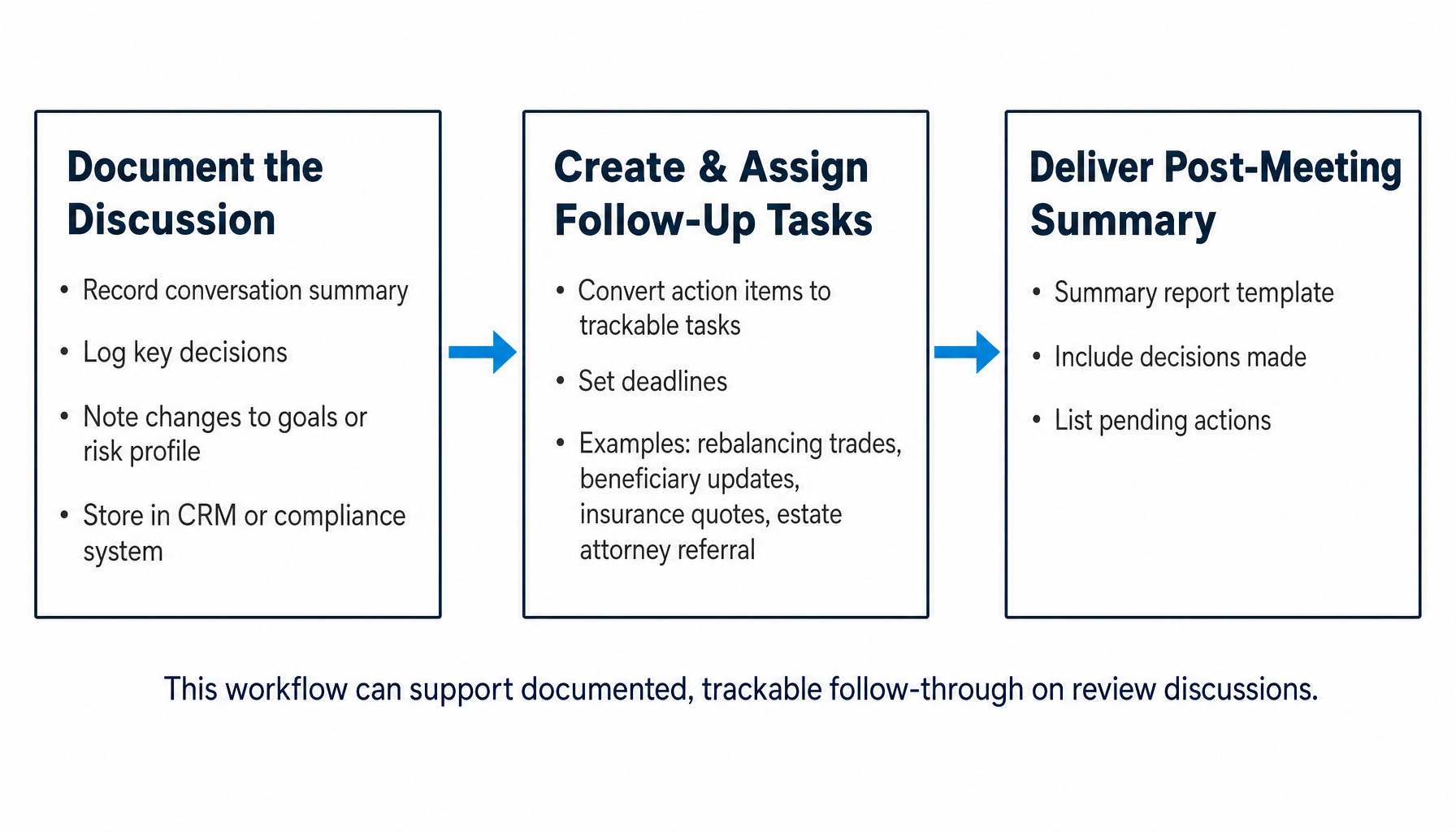
The review workflow can extend beyond the meeting itself. The follow-through workflow plays an important role in turning the discussion into documented outcomes. A checklist can extend past the meeting itself to cover three post-meeting steps:
- Document the Discussion: Record a summary of the conversation, key decisions made, and any changes to the client's goals or risk profile in the firm's CRM or compliance system. This client engagement documentation creates a consistent history of advice that supports the firm's own governance.
- Create and Assign Follow-Up Tasks: Convert action items into trackable tasks with deadlines. This could include initiating rebalancing trades, sending forms for beneficiary updates, requesting insurance quotes, or making a referral to an estate attorney.
- Deliver a Post-Meeting Summary: Many firms use a summary report template that recaps what was discussed, what decisions were made, and what actions are pending.
As an illustration, consider an advisor who identifies three action items in a review but has no systematic way to track their completion. The items may be forgotten, creating gaps in follow-through and documentation. A structured post-meeting workflow, often managed with CRM task automation, can help close this loop and keep follow-through on track.
Standardizing the Review Process Across Advisors and Offices
As firms add advisors, teams, or offices, maintaining consistency in the annual review process can become more complex. Each advisor may have their own preparation habits, agenda items, and documentation methods. For firm leadership, this fragmentation can limit visibility into how reviews are conducted and lead to a less consistent client experience.
Standardization is not about removing advisor autonomy or forcing a scripted conversation. It is about establishing a shared workflow foundation. This means implementing a consistent set of preparation steps, a common library of analytics, and standardized documentation requirements that every advisor uses as a baseline. For example, a firm could require that every annual review presentation includes a consolidated household balance sheet with held-away assets and a drift analysis against the client's IPS.
This shared baseline is designed to support firmwide governance and consistency. It can make the review process less dependent on any single advisor's preparation habits or documentation approach. For firms looking to scale a financial advice practice , this kind of process standardization can be an important contributor to operational maturity.
How VRGL Supports the Annual Review Workflow
One potential source of friction in the annual review process is the gap between raw client data and a clear, client-ready presentation. When firms work across separate tools and manual processes to consolidate accounts, run analytics, and build meeting materials, that preparation can become more manual. A repeatable workflow that connects these steps, from statement intake to analysis to presentation, is the operational need VRGL is designed to address.
As a growth platform for wealth management , VRGL is designed to support the key stages of review preparation. Within the platform, VRGL Core serves as the foundation for that preparation work. Its Statement Extraction capability helps advisors and their teams convert PDF statements from held-away accounts into structured data, reducing the manual data entry involved. That data can then be used in the platform's analytics to support structured analysis across a consolidated household view.
For enterprise firms , it can help standardize the analytics and reporting layer of the review process while advisors continue to lead the client conversation. The intent is to reduce time spent on data assembly, while the advice and the client relationship remain with the advisor.
Firms evaluating their review workflow can find more detail on how VRGL supports these stages in a product demo .
From Checklist to Repeatable System
The preparation workflow behind an annual review checklist is an important contributor to how useful that checklist is in practice. Knowing what to discuss is only part of the picture; having the data, analytics, and documentation systems to discuss it objectively and consistently matters as well. A modern review process moves through scoping the meeting type, preparing consolidated data, running structured analytics, systematically covering planning items, and closing the loop with documented follow-through.
For firms looking to create greater consistency across the review process, systematizing review preparation can help create a more repeatable client experience at scale. A repeatable system of work behind the review can also support more consistent execution across the firm, alongside the judgment and relationship that advisors bring to each conversation.
Frequently Asked Questions (FAQ)
How can an annual review agenda differ for ultra-high-net-worth households compared to other client segments?
UHNW households may involve more complex structures such as multiple entities, concentrated positions, and alternative investments, which can require additional preparation and reporting considerations. The agenda may also include coordination with external tax and legal counsel. Firms with tiered service models may design separate review templates for each segment to reflect these differences in complexity.
What documentation considerations may be relevant to an annual review workflow?
Depending on a firm's policies and review process, documentation considerations may include capturing the rationale behind investment recommendations, noting updates to the client's risk profile when circumstances change, and recording whether beneficiary designation reviews were part of the discussion. Firms may want to evaluate whether their review workflow captures enough detail to support their own governance and oversight framework.
How often do advisors reassess asset allocation drift between annual reviews?
Monitoring cadence and tolerance bands vary based on the firm's investment process, client circumstances, and documented policies. Firms may incorporate drift monitoring between formal reviews based on their own investment and rebalancing framework.
What role does held-away account data play in a comprehensive annual review?
Held-away accounts can be important to understanding a household's broader investment picture. Without this data, an advisor's analysis of risk, diversification, and asset location may leave out a meaningful part of the household picture. Extracting and consolidating this data before a review can help the advisor build a more complete household-level view.
How can firms scale the annual review process as their client base grows?
Systematizing preparation through data extraction, standardized analytics, and reporting templates can reduce manual preparation work and create a more repeatable review process.